
Eagle Mountain Deed Records
Eagle Mountain is one of Utah's newest and fastest-growing cities, located in the western part of Utah County near the Cedar Valley area. Incorporated in 1996, the city has grown from a small rural area to a community of over 40,000 residents in just a few decades. Despite the city's rapid growth, property deed records for Eagle Mountain are not held at City Hall. They are maintained by the Utah County Recorder's Office in Provo. This page explains how to search Eagle Mountain deed records, what tools are available, and what types of documents you may find when researching a property.
Eagle Mountain County Quick Facts
Eagle Mountain Deed Records: Where to Look
Eagle Mountain City maintains a recorder office at 1150 East Pony Express Parkway, Eagle Mountain, UT 84005, phone (801) 789-6600. This office keeps city ordinances, resolutions, and municipal meeting records. It does not hold property deed records for Eagle Mountain real estate.
All deed records for Eagle Mountain properties are filed with the Utah County Recorder. The Recorder's office is at 100 East Center Street, Room 1600, Provo, UT 84606. You can reach them by phone at (801) 851-8163. Provo is the county seat of Utah County, and every deed, trust deed, lien, easement, plat, and related instrument recorded for an Eagle Mountain property is stored there.
This applies to all property transactions in Eagle Mountain, whether residential or commercial, new construction or resale. The Utah County Recorder is the single official source for recorded deed records tied to any parcel within Eagle Mountain city limits.
Note: Because Eagle Mountain was only incorporated in 1996, the earliest deed records for most current parcels may date to subdivision plats filed in the late 1990s and early 2000s. Older records may reflect prior rural or agricultural use of the land.
Eagle Mountain Deed Records and Property Watch Alerts
The Utah County Recorder offers a free Property Watch alert system that lets property owners track recording activity on their Eagle Mountain parcels. This is one of the most practical tools available from the Recorder and costs nothing to use.
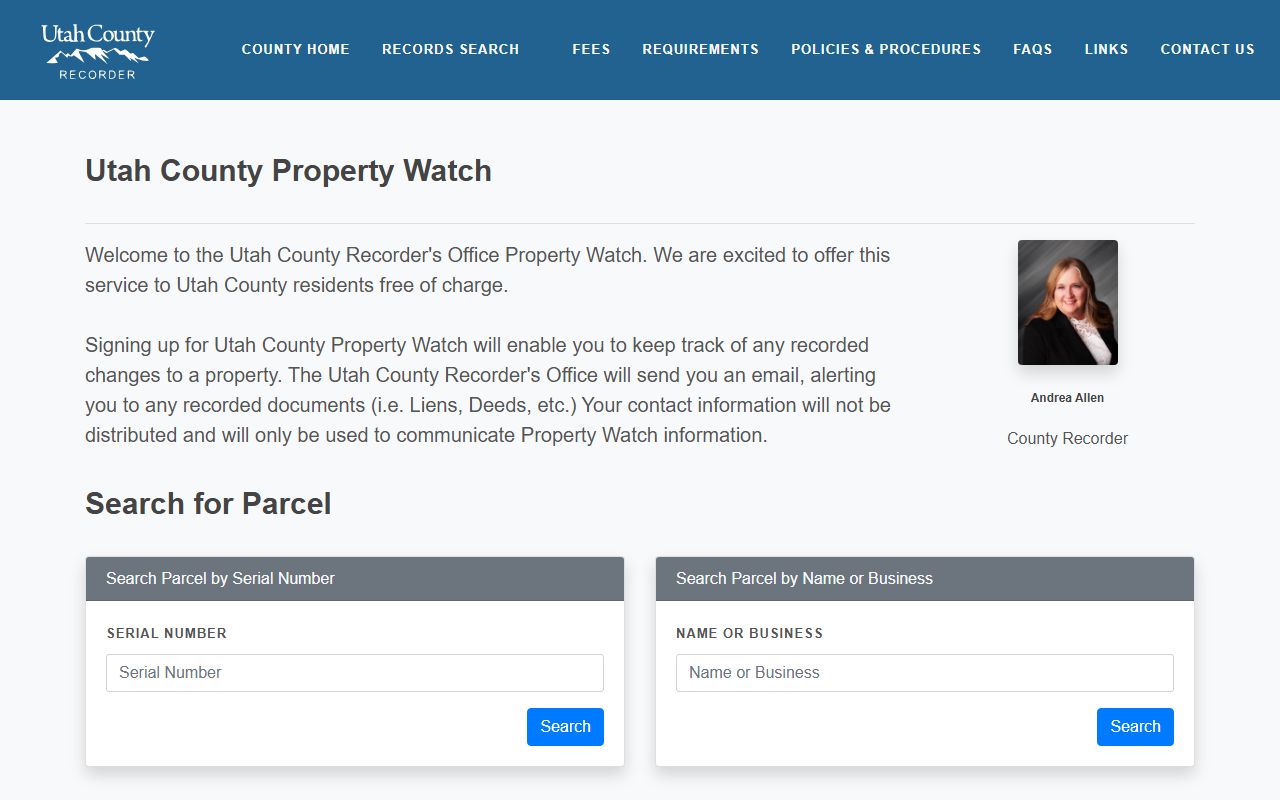
Enrolling in Utah County Property Watch is straightforward. You enter your parcel number and an email address, and the system sends you an alert whenever a new document is recorded against your property. This covers all document types, including deeds, trust deeds, liens, and notices.
For Eagle Mountain homeowners, this service is especially valuable. The city's rapid growth has brought a large volume of new construction activity, refinancing, and property sales. Keeping an eye on recorded activity helps you stay informed about your property's legal status.
Property Watch also serves as an early warning system for deed fraud. If a fraudulent document is recorded against your Eagle Mountain home, you will get an alert right away and can take steps to correct it before more harm is done. This kind of proactive monitoring is easy to set up and free to maintain.
Eagle Mountain GIS Parcel Data and Property Research
When researching Eagle Mountain deed records, knowing the correct parcel number for a property is often the most important first step. The Utah GIS portal and the county's own parcel map both provide this information.

The Utah Geospatial Resource Center offers statewide parcel boundary data, aerial imagery, and GIS datasets. These tools can help you identify the correct parcel for an Eagle Mountain address, especially in newer subdivisions where address databases may lag behind development. Once you have the parcel number, you can use it in the Utah County Recorder's search tools to find the recorded deed records for that specific property.
The Utah GIS data is updated on a regular cycle based on information from county assessors and recorders. It is a useful starting point, but always verify parcel details and legal descriptions through the official Recorder records before relying on them for any legal or financial purpose.
Note: Eagle Mountain's rapid growth means new subdivisions are regularly being platted and recorded. Some GIS data may not yet reflect the very latest plats. If you are researching a property in a brand-new development, contact the Utah County Recorder directly to confirm whether a plat has been recorded.
Types of Deed Records for Eagle Mountain Properties
The Utah County Recorder holds a full range of recorded instruments for Eagle Mountain properties. Given the city's relatively recent incorporation and ongoing growth, a large share of Eagle Mountain deed records reflect new construction sales, subdivision plats, and refinancing activity from the past two decades.
Warranty deeds are the most common transfer instrument in Eagle Mountain residential sales. Builders and developers often use this form when selling new homes. Trust deeds secure the home loans that fund most purchases. When a loan is paid off or a homeowner refinances, a deed of reconveyance releases the prior lien, and a new trust deed may be recorded for the replacement loan.
| Document Type | Typical Use in Eagle Mountain |
|---|---|
| Warranty Deed | New home or resale property transfer |
| Trust Deed | Home loan security instrument |
| Deed of Reconveyance | Lien release after payoff or refinance |
| Quit Claim Deed | Ownership interest transfer without warranty |
| Subdivision Plat | Official map of new subdivision boundaries |
| Notice of Default | First step in foreclosure |
| Easement | Utility or access right recorded on a parcel |
These records are public under Utah GRAMA. You do not need to be the property owner to request copies of recorded documents from the Utah County Recorder.
Utah Code and Property Deed Recording Requirements
Property deed recording in Eagle Mountain follows the same state law that governs all of Utah. Utah Code Title 57 sets out the rules for real property transfers, deed preparation, and the effect of recording on ownership rights.
Utah's race-notice recording system means a deed provides legal notice to the public only after it is recorded with the county recorder. In an Eagle Mountain transaction, the buyer's deed should be recorded as quickly as possible after closing to protect the buyer's ownership interest against any competing claims.
Recording fees are set by the county. The Utah County Recorder charges a base fee per document plus a per-page fee. Most standard residential deeds and trust deeds fall in a predictable cost range. Your title company or closing attorney can provide the exact fee amounts at the time of your transaction.
Once recorded, the Recorder assigns the document a unique instrument number and stamps it with the official recording date and time. This is the official record of when the document was filed and establishes priority among competing claims.
Eagle Mountain Growth and Its Impact on Deed Records
Eagle Mountain's growth story is striking. The city had fewer than 2,000 residents at incorporation. Today it is home to more than 40,000 people, with continued expansion underway. This growth has produced an enormous volume of recorded deed records over a relatively short period.
New subdivision plats have been filed regularly with the Utah County Recorder as developers open new neighborhoods. Each home sale generates a warranty deed and trust deed. Refinancing waves during periods of low interest rates add more trust deeds and reconveyances. The result is a dense and active deed record history for a city that is still very young.
For buyers and sellers in Eagle Mountain, this active market means the chain of title for most properties is still fairly short and easy to trace. Most parcels have only a handful of prior owners. But it is still important to confirm the full chain through the Utah County Recorder before closing any transaction.
The Utah State Archives holds older county-level records and may be a resource if you are researching the agricultural or pre-development history of land in what is now Eagle Mountain. Some early plats and land transfers from the pre-incorporation era may be found there.
Utah County Recorder Access for Eagle Mountain
All Eagle Mountain deed records are on file with the Utah County Recorder. Here is the contact and access information you need to search those records.
| Detail | Information |
|---|---|
| Office Address | 100 East Center Street, Room 1600, Provo, UT 84606 |
| Phone | (801) 851-8163 |
| Property Watch | Free Alert Enrollment |
| Parcel Map | Interactive Parcel Map |
| Utah GIS Data | Utah Geospatial Resource Center |
For help finding a specific Eagle Mountain deed record or to request a certified copy, contact the Utah County Recorder's office by phone or visit in person during business hours.
View Utah County Deed RecordsNearby Cities with Deed Records
Eagle Mountain's neighboring cities are also in Utah County. Deed records for all of them are held by the same Utah County Recorder's Office in Provo.
View All Utah Cities