
Springville Deed Records
Springville sits near the foot of the Wasatch Range in Utah County, about ten miles south of Provo. Known across the state as the "Art City," it has a proud heritage tied to creative traditions and a growing residential community. Property deed records for Springville are not kept at City Hall. They are filed with the Utah County Recorder in Provo. That office records all real estate documents under Utah Code Title 57, making them part of the public record. Whether you need to confirm ownership, trace a chain of title, or review a lien, the county is where those Springville deed records are held.
Springville Quick Facts
Where Springville Deed Records Are Kept
Many people assume that deed records for a city are stored at city hall. For Springville, that is not the case. The Springville City Recorder is located at 50 South Main Street, Springville, UT 84663, and can be reached at (801) 489-2702. That office handles city business such as council minutes, municipal ordinances, and local administrative documents. It does not record or maintain property deeds.
All deed records for land within Springville are filed with the Utah County Recorder. The address is 100 East Center Street, Provo, UT 84606. The office can be reached by phone at (801) 851-8163. Under Utah Code Title 57, any transfer of real property must be recorded with the county recorder in the county where the land sits. Because Springville is in Utah County, every deed, trust deed, lien, and easement tied to property there goes through the Provo office. The recording requirement is set out in § 57-3-101, and the legal effect of recording is described in § 57-3-102.
Utah uses a race-notice recording system. This means a buyer who records first and had no prior notice of a competing claim generally has the stronger legal position. That is why recording quickly matters in any real estate deal in Springville or elsewhere in the state.
Note: The Utah County Recorder's office processes new recordings throughout the business day, and documents are typically available online within one to two business days after recording.
Types of Deed Records in Springville
The Utah County Recorder holds many types of real estate documents that affect Springville properties. Warranty deeds are the most common type used in a standard home sale. The seller guarantees clear title going back through the full ownership history. Quitclaim deeds transfer whatever interest a person has without making any guarantee about the quality of that title. These often appear in family transfers or divorce settlements.
Trust deeds function differently. In Utah, a trust deed is the instrument lenders use when a buyer takes out a mortgage. It places the property in trust until the loan is paid. A reconveyance deed is then recorded when the debt is satisfied. Other documents you may find in Springville deed records include mechanics liens, judgment liens, notice of defaults, easements, and plat maps that define subdivision boundaries.
Each of these document types serves a specific legal function. Together they form the chain of title for a property, which is the record of every ownership change and encumbrance over time. A thorough search of that chain is standard practice before any real estate closing in Springville.
Springville Deed Records Online Access
Utah County offers two main tools for searching Springville deed records from your computer. The first is the Property Watch service. This free tool lets property owners register and receive email alerts when a document is recorded against their address. It is a useful guard against deed fraud, which has become a concern in growing communities like Springville.
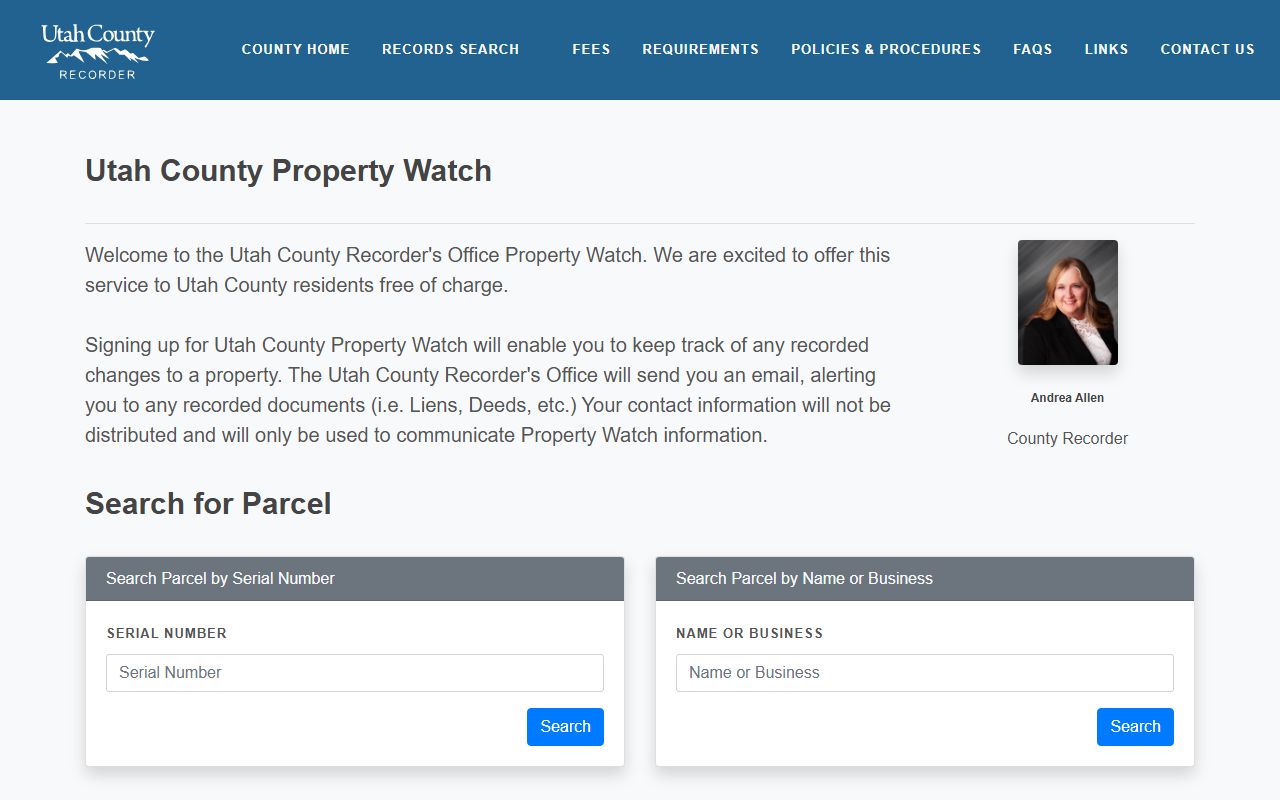
After you sign up through the Property Watch portal, the system monitors recordings tied to your parcel. If a deed, lien, or other document is filed against your Springville property, you get an alert right away. That gives you a chance to act quickly if the filing was not authorized by you.
The second tool is the Utah County Parcel Map. This interactive mapping system lets you click on a parcel in Springville and see key details including ownership, parcel number, and assessed value. You can access it at the Utah County Parcel Map. From the parcel detail screen, you can often link directly to recorded documents in the county's index.
Searching Springville Deed Records by Parcel
To search Springville deed records effectively, start with the parcel number. Every piece of land in Utah County has a unique parcel identification number assigned by the county assessor. That number is the fastest way to pull up all recorded documents for a specific property. You can find the parcel number through the county's online map or by calling the recorder's office.
Once you have the parcel number, the county's online index lets you search by that number or by the owner's name. Grantor and grantee indexes allow searches by the name of the person who transferred ownership (grantor) or the person who received it (grantee). These indexes go back many decades and are the standard tool for tracing a Springville property's history.
Under GRAMA, Utah Code § 63G-2, deed records are public records. Any person can request copies. The county recorder's office provides certified copies for a per-page fee. Certified copies carry the recorder's official stamp and are accepted in legal proceedings.
Note: When searching older Springville deed records, names may be spelled inconsistently across documents, so try alternate spellings when using name-based indexes.
Utah GIS and Parcel Data for Springville
Beyond the county tools, the state's geospatial resources offer another layer of detail for Springville deed research. The Utah Geographic Information Systems (GIS) portal provides statewide parcel data that can be overlaid with other map layers. This can help you understand property boundaries, nearby easements, and the relationship between parcels before you request formal deed records from the county.

The Utah GIS portal is maintained by the Utah Automated Geographic Reference Center (AGRC). Parcel data is updated regularly from county sources. For Springville, the data reflects Utah County's records. While this tool does not replace a formal title search, it is a practical starting point for understanding the layout of land in a specific area. Researchers, developers, and property owners all use it as part of their due diligence process.
Recording a Deed in Springville
If you need to record a new deed for Springville property, you submit it to the Utah County Recorder in Provo, not to the city. Documents can be submitted in person at the office or by mail. Utah County also accepts electronic recording through approved e-recording vendors, which speeds up the process considerably for title companies and law firms that record frequently.
Before recording, the deed must meet the requirements in § 57-3-101 and § 57-3-103 of the Utah Code. This includes a legal description of the property, the names of the grantor and grantee, the consideration paid (even if nominal), notarization, and the proper format for the first page. The county recorder will reject documents that do not meet these standards. Getting these details right before submission avoids delays.
Recording fees in Utah County are set by the county and are subject to periodic change. Contact the recorder's office directly for the current fee schedule before submitting. Once recorded, the document becomes part of the permanent public record and is indexed under the grantor and grantee names as well as the parcel number.
Historical Deed Records for Springville
Springville was settled in the 1850s, and its earliest property records date to that era. Historical deed records from Utah's territorial period are preserved by the Utah State Archives. For records from the late 1800s and early 1900s, the archives can be a valuable supplement to what the county holds. Some older documents have been digitized, while others require an in-person visit or a formal records request.
Genealogists and historians frequently use historical Springville deed records to trace land ownership through generations of a family. Deeds from that era often contain detailed descriptions of land boundaries using natural landmarks and chain measurements, providing a vivid picture of how the land was divided and transferred over time.
Note: For deed records predating electronic indexes, allow extra time when requesting copies since staff must locate physical documents in older ledger books or microfilm.